

For early-stage startups, especially those in B2B or hardware, proving market demand before your product is fully built feels like a Catch-22. Investors demand proof that customers want what you are building, while prospective clients hesitate to pay for software that isn't completely finished. This is where one of the most powerful tools in the startup playbook comes in: The Letter of Intent (LOI).
What is an LOI (and what is it not)?
At its core, a Letter of Intent is a formal, non-binding document where a prospective client expresses a serious commitment to purchase or pilot your product once specific criteria are met. Think of it as the bridge between a polite sales call and an official, legally binding enterprise contract.
To understand its value, look at the traction spectrum:
- it moves from Verbal Interest (client says: We love this!) which carries low credibility with investors,
- to a Letter of Intent (client says: We will buy this for $20k if X, Y, and Z work), which is a strong investor signal,
- and finally to a Paid Contract (client says: Here is the signature) and the equals to an actual revenue.
An LOI converts subjective enthusiasm into formal, written evidence. It signals to investors that you aren't just getting nice compliments on discovery calls, you are securing actionable commercial commitments.
The anatomy of an investor-grade LOI
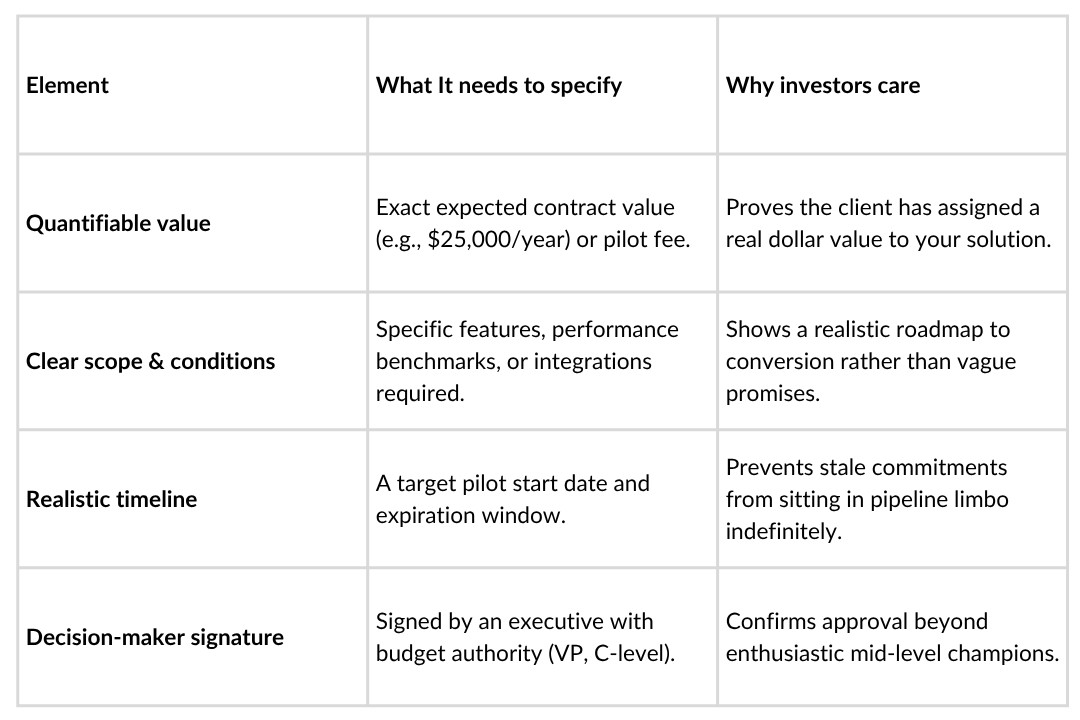
Not all LOIs carry equal weight. An informal email from a manager saying "We'd love to try this out sometime" will quickly be dismissed during investor due diligence. To make an LOI carry real weight, it must contain four key elements:
Five tips for getting clients to actually sign
Getting a prospective client to put ink on paper for an unreleased product can feel daunting. Here is how top accelerator alumni turn early discovery calls into executed LOIs:
Frame is as VIP access: Treat this paper as a way to hold their spot, not a sales pitch. Remind them that spots are limited, and signing the document guarantees that your team will build the features they need first.
Remove financial risk: Make it completely risk-free for them. Clearly state that this agreement isn't legally binding: if your product doesn't meet the promised goals, they can walk away without paying a single cent.
Cut down the paperwork: Keep the paperwork short and simple. Skip the 10-page legal contracts and use a clear, 1-to-2 page document. Short contracts can be approved in days instead of getting stuck in corporate legal review for months.
Build goals around client´s needs: Set the success rules together. Work with the client to write down what success looks like. When the agreement focuses on solving their specific goals, signing the document feels like working on their own project rather than taking a risk on you.
Add a clear deadline. Never leave the document open-ended. Include a specific expiration date and a set testing period (like 21 to 30 days) so everyone stays on track and moves the deal forward.
The ultimate rule: be honest with investors
While a portfolio of signed LOIs will significantly boost your fundraising pitch deck, experienced VCs will test them during due diligence. Always be upfront about where each LOI stands:
- Have their security teams officially approved it?
- Have they set aside actual money for it?
- What features do you still need to build before they pay?
Transparency builds trust. Showing a clear line of sight from an LOI to a paid contract proves you aren't just a founder with a good pitch, you're an executive who knows how to execute.
