

Authored by Darius Mureșan, Founder & CEO of TrustPass, a startup accelerated in AceON Accelerator.
A decade ago, I noticed every website required a new username and password, a ritual of fragmented identity no one questioned. Then came “Login with Google”, simple and convenient, yet it centralized control of our digital trust in the hands of a few corporations.
Two years ago, I decided to dedicate myself entirely to this problem. Around that time, the rapid rise of blockchain and decentralized technologies sparked a global shift and people began to crave autonomy, privacy, and control. But paradoxically, the movement that promised freedom became another story of centralization - platforms and intermediaries still holding the keys to users’ data.
That’s when I understood: the internet wasn’t established with a reliable and trusted way to manage digital identities.
Everything that followed, from federated logins to centralized providers, has been an attempt to patch that missing layer. But for the first time in history, we now have the technology, regulation, and collective will to rebuild it the right way through Self-Sovereign Identity (SSI) and the upcoming EU initiatives.
Why the internet was never designed to manage our identities
When the internet was created, it was meant to connect information, not people. It had no built-in concept of who is accessing data, how they prove their authenticity, or what trust exists between two digital parties. For over three decades, we have relied on temporary solutions: usernames, passwords, and, later, federated systems like Single Sign-On (SSO) and Multi-Factor Authentication (MFA). These technologies brought convenience, but identity became centralized and fragmented, controlled by large intermediaries that dictate access, store our personal data, and often monetize our digital footprint.
This model is now collapsing under its own weight, exposed by growing security breaches, privacy violations, trust deficit and regulatory pressure for change.
.png)
➡️ The critical challenges of today’s identity layer
- Fragmented authentication & user experience. Users demand seamless authentication and secure data sharing, but current systems remain inconsistent and siloed across platforms and countries. Accenture found that 75% of global businesses see interoperability and portability of digital identity credentials as critical for the future of cross-border transactions.
- Limited data control & transparency. Individuals have little control over how their data is collected, shared, or monetized, often without explicit consent.
- Unequal market conditions across the EU. Trust service providers operate under inconsistent rules, creating barriers for cross-border identity verification and stifling innovation.
- Growing market fragmentation. The rise of private, non-interoperable eID solutions risks further centralization under a few dominant online platforms, leading to vendor lock-in, reduced value creation, and dependencies that threaten Europe’s digital autonomy.
- Lack of privacy safeguards. Without uniform privacy and data protection standards for identity providers, users remain exposed to misuse and surveillance risks.
The solution: The role of Self-Sovereign Identity (SSI)
Self-Sovereign Identity (SSI) is not just a technology, it’s a paradigm shift. It redefines how identity is created, verified, and managed, giving individuals and organizations control, interoperability, and trust across the entire digital ecosystem.
SSI enables verifiable credentials that are cryptographically secure, privacy-preserving, and reusable across contexts - without centralized databases or third-party dependence. EUDI wallets are the first large-scale implementation of this vision, aligning Europe’s regulatory landscape with the most advanced technological frameworks for decentralized identity.
➡️ First, what is digital identity?
Before diving into how SSI works, it’s important to clarify what digital identity actually means. A digital identity is a collection of data that represents an individual or organization in the online world, for example your name, date of birth, national identifier, academic records, or login credentials. In today’s systems, this information is often stored by third-party providers, creating fragmentation, privacy risks, and dependency on centralized platforms.
➡️ How SSI works
Self-Sovereign Identity or SSI refers to a decentralized approach where individuals do not rely on a third-party provider. They can store their identity information securely and in a private way on their personal device using cryptographic techniques and therefore not even the Self-Sovereign Identity system provider knows what is being stored or exchanged. Additionally, by leveraging blockchain technology's transparency properties, SSI addresses fundamental trust concerns in identity management. The process of issuing credentials becomes more efficient. Plus, they can selectively disclose personal data only showing piece of information that are required to trusted entities or service providers.
The technology enables credential verification anytime, anywhere, even if the original issuing organization is no longer operational. Instead of being stored on servers, the data is kept by the user. This eliminates the need to remember multiple passwords, as you only need to remember the password to your wallet.
Today, SSI is widely associated with decentralized identity, and in many contexts the two terms are used interchangeably.
➡️ The SSI ecosystem is built around three core roles
Holder (User) is the person or organization that manages their digital identity through a wallet application and securely stores the verifiable credentials they receive (for example, a citizen using a digital wallet to store their ID card, a student keeping a digital diploma, an employee holding a digital work certificate).
Issuer is a trusted entity with the authority to create, sign, and issue verifiable credentials to users (such as a government issuing digital IDs or passports, a university issuing diplomas, a bank issuing KYC verification, an employer issuing employment credentials).
Verifier is the party that requests, checks, and validates the credential or proof presented by the holder (e.g. an employer verifying a diploma, an online shop checking age verification, a bank validating identity for onboarding, an airport authority confirming travel document).
.png)
The interactions between the holder, issuer, and verifier is often described as a “trust triangle.” Whenever a verifier requests information, the holder remains in control and decides whether to approve or deny access to their data. SSI forms the technological foundation for a more secure, private, and user-controlled identity ecosystem. However, technology alone is not enough - true large-scale adoption requires regulatory alignment, common standards, and a unified framework that works across countries, sectors, and institutions.
This is where Europe steps in.
Europe’s answer: The EUDI Wallets and eIDAS 2.0
The European Union is taking a historic step to fix this foundational problem. Lead by long lasting challenges, the European Digital Identity (EUDI) Wallets and the revised eIDAS 2.0 Regulation (EU 2024/1183), EU aims to create a trusted, secure, and interoperable digital identity framework for all citizens and organizations.
The EUDI Wallet will allow individuals and businesses to store, manage, and share verifiable credentials, from passports and diplomas to bank credentials or business certificates, with full control over what data is shared, with whom, and for how long.
This is not merely a compliance requirement, it’s the beginning of rebuilding the trust layer of the internet. For the first time, we are shifting from identity owned by platforms to identity owned by people.
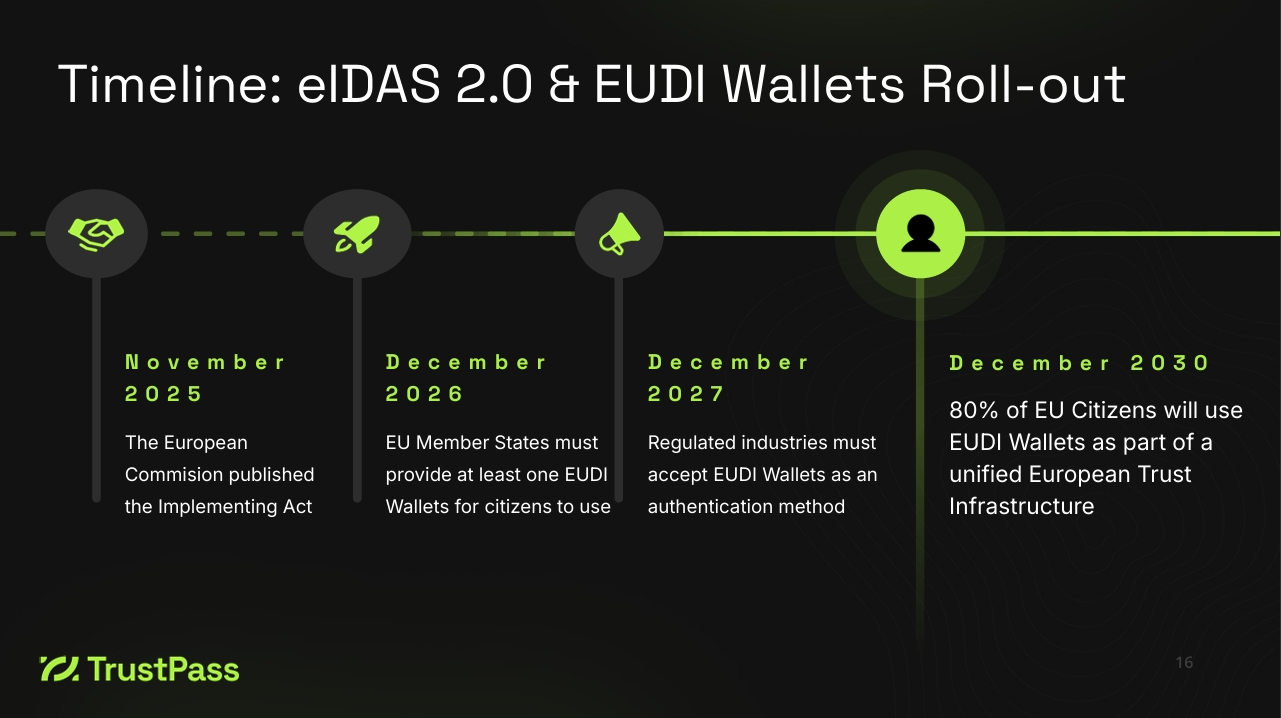
The regulation entered into force on May 2024. What´s next? Member States are required to make at least one EUDI Wallet available to citizens, residents and businesses within 24 months after the adoption of the implementing acts (i.e., by late 2026 at the latest). Private-sector relying parties that are legally required to use strong user authentication are expected to accept EUDI Wallets within 36 months of the implementing acts - pointing toward a rollout of wallet acceptance by late 2027.
What does it mean for you?
➡️ For citizens and users
By 2026, all EU Member States are required under eIDAS 2.0 to provide citizens with a digital identity wallet. This will transform how Europeans interact online, making digital experiences more secure, seamless, and privacy-centric. The wallet will store essential credentials such as national ID, passport, driver’s license, diplomas, and more, enabling users to complete tasks like traveling, applying to a university, or opening a bank account effortlessly. Built on privacy-by-design principles and zero-knowledge proofs, the EUDI Wallet ensures maximum data protection and includes mandatory security audits. It will also allow users to electronically sign documents with legal validity equivalent to handwritten signatures.
Benefits for individuals:
- Seamless access to public and private services: no passwords or repeated forms.
- Full control over personal data across multiple platforms and sectors.
- Privacy-preserving data sharing: no paper documents needed (according to Termly, 91.1% of businesses would prioritize data privacy if it increased customer trust and loyalty).
- Reduced risk of identity theft and online fraud: with identity fraud growing by 88% across the EU in just four years, the need for secure and privacy-preserving identity tools has never been greater.
➡️ For companies and institutions
By 2026, businesses across all sectors will also be impacted by eIDAS 2.0, which mandates the ability to issue, verify, and interact with decentralized identity credentials. While compliance will become essential, it also creates major opportunities for innovation and growth.
Benefits for businesses:
- Better user experience: streamlined onboarding and faster access to services (for example, digital wallets could reduce customer friction by an estimated 40-60% in KYC flows).
- Higher conversion & retention: improved customer satisfaction and trust.
- Improved data quality & lower operational costs: access to verified, tamper-proof credentials that streamline processes, reduce manual verification, and cut compliance expenses - some reports suggest up to a 30% reduction in manual processing costs.
- Enhanced security & fraud prevention: protects against identity theft, forgery, and data breaches through password-free authentication and decentralized storage.
➡️ Industries most impacted by eIDAS 2.0 and EUDI Wallet
- Finance & Fintech: digital onboarding, KYC/AML automation, and secure transaction authorization.
- Education & Academia: issuing verifiable diplomas, student IDs, and academic credentials.
- Public administration: citizen identification, eGovernment services, and electronic signatures.
- E-Commerce: identity verification for purchases, age checks, and fraud prevention.
- Healthcare: secure access to patient records and digital prescriptions.
- Mobility & Travel: seamless travel identity verification and borderless EU movement.
The EU framework targets that by 2030, 80% of citizens will be able to use a digital identification solution to access public services.
TrustPass: Digital trust as your competitive advantage
Our mission is to create the next layer of digital trust for the emerging trust economy, powered by Self-Sovereign Identity (SSI) and the latest technological advancements in the identity sector.
We help organizations leverage the benefits of SSI technology while ensuring they remain compliant, efficient, and prepared for the new technological and regulatory landscape - one that is compatible with EUDI Wallets, aligned with eIDAS 2.0, and equipped with the infrastructure to unlock the full potential of decentralized digital identity - giving users complete control over their data, ensuring nothing is misused, exposed, or monetized without consent.
TrustPass bridges the gap between the current challenges of digital identity, the new regulatory frameworks like eIDAS 2.0, and the future innovations shaping this sector.
➡️ Strategic pilots driving real-world adoption
As Europe transitions toward decentralized identity, TrustPass is focusing on two high-impact pilot implementations designed to demonstrate the immediate value and real-world viability of SSI. These domains were selected because they create network effects, accelerate adoption, and solve long-standing pain points.
1. Academic institutions: cross-border academic credentials
- Pilot scope: facilitating EU students with cross-border recognized academic credentials (Bachelor, Masters, PhD, StudentID, etc), directly through the TrustPass Wallet.
- This unlocks fast enrollment, simplified mobility, and recognition of qualifications across universities, completely removing paperwork and manual verifications.
2. Financial institutions: reusable KYC & remote banking
- Pilot scope: supporting fully remote banking operations across the EU using reusable KYC, verified identity attributes, and financial credentials powered by the TrustPass Wallet.
- This reduces customer onboarding friction, increases security, and cuts operational costs for banks by replacing repetitive KYC checks with a single, reusable, verifiable credential set.
These two initial use cases will be fundamental in accelerating mass adoption, proving the paradigm shift, and unlocking cross-sector integrations as the ecosystem expands. Our roadmap extends into governmental and public-sector deployments, where digital identity standardization is essential and where TrustPass can deliver the most impact.
With ongoing R&D in zero-knowledge proof authentication and privacy-preserving login flows, TrustPass aims to replace centralized identity models such as “Login with Google” with a user-controlled, secure, and interoperable SSI alternative truly returning digital identity to the hands of the individual.
The transition towards SSI and EUDI wallets is already accelerating, and early adopters will be the ones that define the standards of tomorrow.
The future of digital trust is unfolding now. Let’s build it together. Reach out, schedule a demo, and explore how TrustPass can support your digital identity transformation.
Schedule a demo
📧 LinkedIn: Darius Mureșan, CEO of TrustPass
